Views: 3
A complete guide for Indian business owners, startups, and creators
Table of Contents
Introduction
If you own a business, create content, or have invented something — protecting your intellectual property is one of the most important legal steps you can take. But most people get confused between three key protections: Trademark, Copyright, and Patent.
They sound similar. They’re all about “protecting your work.” But they protect completely different things, work in different ways, and come with different rules.
This blog breaks it all down in simple language — no legal jargon, just clarity.
What is Intellectual Property (IP)?
Intellectual Property refers to creations of the mind — a brand name, a logo, a book, a song, an invention, a software, a formula. Since these are intangible assets, the law provides specific protections so the creator or owner can benefit from their work and prevent others from misusing it.
The three main types of IP protection in India are:
- Trademark — protects your brand identity
- Copyright — protects your creative work
- Patent — protects your invention
Let’s understand each one in detail.
1. What is a Trademark?
A Trademark is a sign, symbol, word, phrase, logo, or combination that identifies and distinguishes the goods or services of one business from another.
Think of it this way — when you see the golden arches, you instantly think of McDonald’s. When you hear “Just Do It,” you think of Nike. That recognition is the power of a trademark.
What can be trademarked?
- Business names and brand names
- Logos and symbols
- Taglines and slogans
- Unique packaging (trade dress)
- Sounds and colours (in some cases)
What does it protect?
It protects your brand identity in the marketplace. It prevents competitors from using a similar name or logo that could confuse customers.
Who should apply?
- Business owners
- Startups
- Entrepreneurs
- E-commerce sellers
- Service providers
Key facts about Trademark in India
- Governed by the Trade Marks Act, 1999
- Registered under the Trade Marks Registry (under CGPDTM)
- Valid for 10 years, renewable indefinitely
- Covers specific classes (there are 45 classes of goods and services)
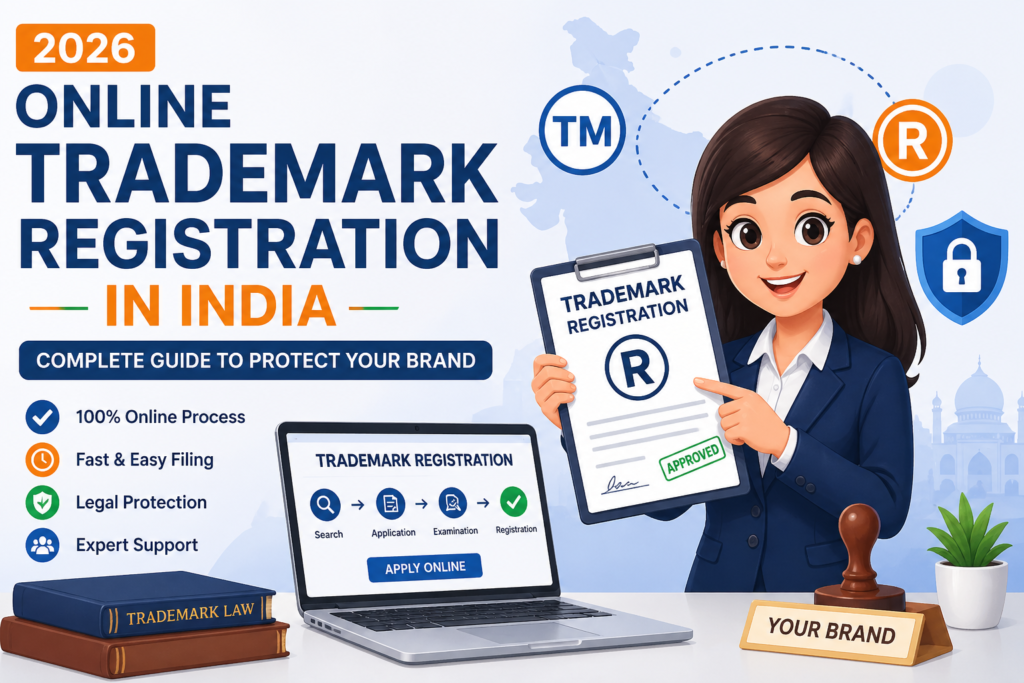
- You can use ™ after filing and ® only after registration is granted
- Can be registered at any of the 5 offices: Mumbai, Delhi, Chennai, Kolkata, Ahmedabad
Example
You start a legal consultancy called “LexBridge.” By registering it as a trademark, no other firm in the same category can legally use the name “LexBridge” or a confusingly similar name.
2. What is Copyright?
Copyright is an automatic legal protection given to original creative works as soon as they are created. You do not need to register copyright for it to exist — but registration gives you legal proof of ownership.
What can be copyrighted?
- Books, articles, blogs, poems
- Music and sound recordings
- Films and videos
- Paintings, drawings, photographs
- Software code
- Websites and digital content
- Architecture designs
What does it protect?
It protects the expression of an idea — not the idea itself. For example, two people can write a book about the same topic, but neither can copy the other’s exact words.
Who should apply?
- Writers and authors
- Musicians and composers
- Filmmakers
- Software developers
- Artists and photographers
- Content creators and YouTubers
Key facts about Copyright in India
- Governed by the Copyright Act, 1957
- Administered by the Copyright Office under the Ministry of Education
- No mandatory registration — copyright exists from the moment of creation
- Registration provides legal evidence and makes enforcement easier
- Valid for the lifetime of the author + 60 years
- For films, sound recordings, and anonymous works — 60 years from publication
Example
You write a detailed guide on GST compliance. The moment you write it, you own the copyright. No one can copy, reproduce, or publish your guide without permission. If someone does, you can take legal action.
3. What is a Patent?
A Patent is an exclusive right granted to an inventor for a new invention that is useful, novel, and non-obvious. In exchange for disclosing the invention publicly, the government grants the inventor exclusive rights to make, use, and sell it for a limited period.
What can be patented?
- New machines or devices
- New chemical compounds or formulas
- New manufacturing processes
- New software (with technical application)
- New pharmaceutical drugs
- Biotechnology innovations
What cannot be patented in India?
- Abstract theories or mathematical methods
- Business methods alone (without technical application)
- Traditional knowledge (e.g., turmeric’s healing properties)
- Discoveries of natural phenomena
- Surgical or diagnostic methods
What does it protect?
It protects your invention or innovation — giving you the exclusive right to commercialise it and stopping others from making, selling, or using it without your permission.
Who should apply?
- Inventors and innovators
- R&D companies
- Pharmaceutical companies
- Tech startups
- Manufacturing businesses
Key facts about Patent in India
- Governed by the Patents Act, 1970 (amended 2005)
- Administered by the Indian Patent Office (offices in Mumbai, Delhi, Chennai, Kolkata)
- Valid for 20 years from the date of filing — not renewable
- Must be novel, involve an inventive step, and be capable of industrial application
- Provisional application can be filed first to secure a priority date
- India is a member of the Patent Cooperation Treaty (PCT) — allows international filing
Example
You develop a new water purification device that uses a unique process. By filing a patent, you have the exclusive right to manufacture and sell it in India for 20 years. Any company that wants to use your technology must take a licence from you.
Side-by-Side Comparison
| Feature | Trademark | Copyright | Patent |
|---|---|---|---|
| What it protects | Brand identity | Creative works | Inventions |
| Examples | Logo, name, slogan | Book, music, code | Machine, drug, process |
| Registration required? | Yes (recommended) | No (automatic) | Yes (mandatory) |
| Duration in India | 10 years (renewable) | Life + 60 years | 20 years (not renewable) |
| Governing law | Trade Marks Act, 1999 | Copyright Act, 1957 | Patents Act, 1970 |
| Governing body | Trade Marks Registry | Copyright Office | Indian Patent Office |
| Symbol | ™ (pending) / ® (registered) | © | No symbol |
| Who needs it | Business owners | Creators & artists | Inventors |
| Protection scope | Same class/industry | Worldwide automatically | India only (unless PCT) |
| Cost (approx.) | ₹4,500–₹9,000 (govt fee) | ₹500–₹2,000 | ₹1,600–₹8,000+ |
Can You Have All Three?
Yes — and many businesses do.
Consider a pharmaceutical company that:
- Patents a new drug formula (protects the invention)
- Trademarks the brand name and logo of the drug (protects the brand)
- Copyrights the product literature, packaging design, and marketing materials (protects the creative work)
Each protection serves a different purpose and they work together to give complete IP protection.
Common Mistakes People Make
1. Thinking copyright protects a brand name Many small business owners believe that because they wrote their logo or brand name, they own it via copyright. Copyright protects the artistic design of a logo, not the name itself. For the name, you need a trademark.
2. Using ® before registration is granted Using the ® symbol before your trademark is officially registered is illegal in India. You can only use ™ during the application period.
3. Not filing a patent early enough Patent protection is lost if you publicly disclose your invention before filing. Always file first, disclose later.
4. Assuming copyright registration is not needed While copyright is automatic, unregistered works are harder to enforce in court. Registration creates a public record and legal presumption of ownership.
5. Registering a trademark in only one class If your business operates in multiple product or service categories, you need to register in each relevant class separately.
Which One Do You Need?
You need a Trademark if: You run a business, have a brand name or logo, sell products or services, or want to stop competitors from copying your brand.
You need Copyright if: You create content — blogs, videos, music, books, software, photographs — and want legal proof of ownership and protection against copying.
You need a Patent if: You have invented something new, useful, and unique — a product, process, or technology — and want exclusive commercial rights over it.
How to Apply in India
Trademark
- Conduct a trademark search on the IP India website
- Identify the correct class(es) for your goods/services
- File application on ipindia.gov.in or through a registered trademark agent
- Examination, publication in Trademark Journal, opposition period
- Registration certificate issued if no objection
Copyright
- Visit copyright.gov.in
- Create an account and fill in the application form
- Upload your work and pay the fee
- Diary number issued immediately; certificate after examination
Patent
- Conduct a prior art search
- File provisional or complete specification on ipindia.gov.in
- Publication after 18 months
- Examination request (must be filed within 48 months)
- Grant after examination and objection clearance
Conclusion
Trademark, Copyright, and Patent are three pillars of Intellectual Property protection — each designed for a specific purpose.
- Trademark = Your brand. Protect it so no one steals your identity.
- Copyright = Your creativity. Protect it so no one profits from your work.
- Patent = Your invention. Protect it so no one copies your innovation.
If you are a business owner in India, at minimum you should have your trademark registered. It is one of the most affordable and impactful legal steps you can take to protect your business.
Need help with Trademark Registration, Copyright, or Patent filing? Our team of expert CAs, CSs, and Advocates can guide you through the entire process. Contact us today for a free consultation.

I’m Aman Arora aka Aman G — 10+ years in SEO and Digital Marketing, and I love getting results. I don’t just do SEO & Website Design; I build strategies that work. I’m a CA drop out, but what I enjoy most is helping entrepreneurs and NGOs reach their goals. For me, happy customers are the real reward.