Views: 0
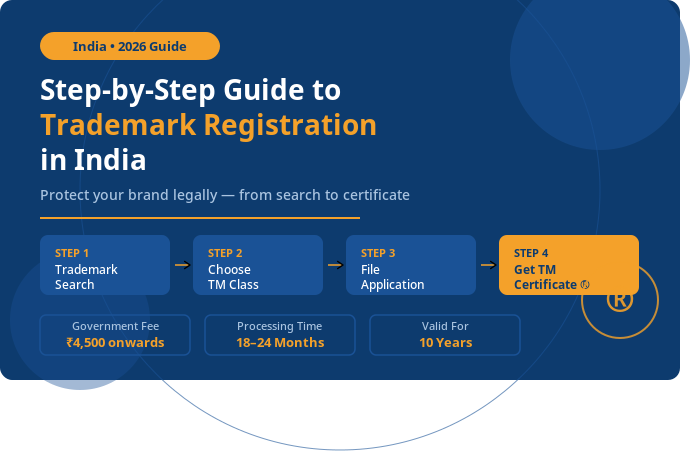
Table of Contents
Introduction
Guide to Trademark Registration in India is what every business owner, startup founder, and entrepreneur needs in 2026. Your brand is one of your most valuable business assets. Whether it’s your business name, logo, slogan, or product name — protecting it legally is not optional, it’s essential.
In India, trademark registration gives you the exclusive right to use your brand identity and take legal action against anyone who copies or misuses it.
But many business owners delay registration because the process seems complicated. The truth is, with the right guidance, registering a trademark in India is straightforward and affordable.
This complete guide to trademark registration will walk you through everything you need to know — step by step — in 2026.
What Is a Trademark?
A trademark is a unique sign, symbol, word, phrase, logo, or combination that identifies your goods or services and distinguishes them from others in the market. In India, trademarks are governed by the Trade Marks Act, 1999, and administered by the Office of the Controller General of Patents, Designs and Trade Marks (CGPDTM).
Once registered, you get the right to use the ® symbol and legally protect your brand across India.
Why You Need a Guide to Trademark Registration
Before jumping into the process, here’s why trademark registration is worth it:
- Legal Protection — You can sue anyone who copies or imitates your brand.
- Exclusive Rights — No one else can use your brand name or logo in the same industry.
- Brand Trust — A registered trademark builds credibility with customers and investors.
- Business Asset — A trademark can be licensed, sold, or franchised for revenue.
- Nationwide Recognition — Registration gives you rights across all of India.
Without a proper guide to trademark registration, most applicants make costly mistakes that delay or derail the process entirely.
Step-by-Step Guide to Trademark Registration in India
Step 1 — Conduct a Trademark Search
The first step in any guide to trademark registration is checking whether your desired trademark is already registered or applied for by someone else. Skipping this step is the biggest mistake applicants make.
How to do it: Go to the official IP India website — ipindia.gov.in — and use the Trademark Public Search tool. Search by wordmark, logo, or class to check for existing similar trademarks.
What to look for:
- Identical trademarks in your industry
- Phonetically similar names
- Visually similar logos
If your trademark is unique and clear, you can move to the next step. If it conflicts with an existing one, it’s better to modify your brand name before filing.
Step 2 — Identify the Right Trademark Class
India follows the Nice Classification system, which divides goods and services into 45 classes. Your guide to trademark registration must include choosing the correct class based on your business type.
Examples:
- Class 25 — Clothing, footwear, headgear
- Class 35 — Advertising, business management, retail services
- Class 41 — Education, entertainment, training
- Class 42 — Technology, software, IT services
- Class 44 — Medical, beauty, healthcare services
Choosing the wrong class can weaken your trademark protection, so take time to identify the right one. You can apply under multiple classes if your business operates across different industries.
Step 3 — Prepare Your Application Documents
Once your search is complete and the class is identified, gather the required documents for filing. This is a critical part of any guide to trademark registration in India.
Documents required:
- Name and address of the applicant
- Clear representation of the trademark (wordmark or logo in JPEG format)
- Description of goods or services
- Date of first use (if the mark is already in use)
- Power of Attorney (if filing through a trademark agent)
- Business registration proof (for companies and LLPs)
- MSME or Udyam Registration Certificate (for fee concession)
Step 4 — File the Trademark Application
You can file your trademark application in two ways:
Option A — Online Filing Visit the IP India e-filing portal at ipindiaonline.gov.in. Create an account, fill in Form TM-A, upload documents, pay the fee, and submit.
Option B — Physical Filing Visit the nearest Trademark Registry Office in Mumbai, Delhi, Kolkata, Chennai, or Ahmedabad and submit your application in person.
Online filing is recommended as it is faster, paperless, and you receive an acknowledgment immediately.
Government Fee:
- Individual / Startup / MSME — ₹4,500 per class (online)
- Company / LLP / Others — ₹9,000 per class (online)
Step 5 — Receive Trademark Application Number
Once your application is submitted, you will receive a unique Trademark Application Number. This is important because:
- You can use the ™ symbol immediately after filing
- You can track the status of your application online
- It serves as proof that you have claimed the trademark
Note: You can only use the ® symbol after your trademark is officially registered, not before.
Step 6 — Examination by the Trademark Office
After filing, the Trademark Office assigns your application to an examiner. The examiner reviews your application and issues an Examination Report, usually within 1 to 3 months.
The examiner checks for:
- Similarity with existing trademarks
- Whether the mark is distinctive
- Compliance with the Trade Marks Act
Two possible outcomes:
Accepted — Your trademark is accepted and moves to publication in the Trademark Journal.
Objected — You receive a trademark objection with reasons. You must file a Reply to Objection within 30 days explaining why your trademark should be registered.
Step 7 — Reply to Objection (If Applicable)
If you receive an objection, do not panic. It is very common and does not mean your application is rejected. You need to file a written reply addressing the examiner’s concerns.
A well-drafted reply backed by legal arguments, evidence of use, and brand distinctiveness can overcome most objections. If required, a personal hearing may also be granted.
This step is best handled by a trademark attorney or agent for the best outcome.
Step 8 — Publication in the Trademark Journal
Once accepted, your trademark is published in the official Trademark Journal. This is a public notice that gives third parties an opportunity to oppose your trademark if they believe it conflicts with their existing rights.
The opposition window is 4 months from the date of publication.
If no opposition is filed — Your trademark moves directly to registration.
If opposition is filed — Both parties present their case before the Trademark Hearing Officer and a decision is made.
Step 9 — Trademark Registration Certificate
If no opposition is filed or if you successfully overcome an opposition, the Trademark Registry issues your Registration Certificate.
Your trademark is now officially registered under the Trade Marks Act, 1999. You can now:
- Use the ® symbol legally
- Enforce your trademark rights in court
- License or assign your trademark to others
The entire process from filing to registration typically takes 18 to 24 months in India.
Step 10 — Renew Your Trademark Every 10 Years
A registered trademark in India is valid for 10 years from the date of application. After that, it must be renewed every 10 years to remain active.
Renewal can be done 6 months before the expiry date using Form TM-R. If you miss the deadline, there is a grace period of 6 months with a late fee. After that, the trademark lapses and can be removed from the register.
How Long Does the Entire Process Take?
| Stage | Estimated Time |
|---|---|
| Trademark Search | 1 to 2 days |
| Application Filing | 1 day |
| Examination Report | 1 to 3 months |
| Reply to Objection | 30 days (if applicable) |
| Journal Publication | 3 to 4 months after acceptance |
| Opposition Period | 4 months |
| Registration Certificate | 1 to 3 months after opposition period |
| Total | 18 to 24 months |
Tips to Speed Up the Process
Following this guide to trademark registration carefully will save you time, but here are additional tips:
- File online to avoid delays
- Conduct a thorough trademark search before filing
- Choose a distinctive and unique mark
- Respond to objections promptly and professionally
- Hire a trademark professional to handle the process
Common Mistakes to Avoid
Even with a guide to trademark registration in hand, people still make these errors:
- Skipping the trademark search
- Choosing a generic or descriptive name
- Applying under the wrong class
- Using ® before registration is confirmed
- Missing objection reply deadlines
- Not renewing the trademark on time
Should You Hire a Trademark Agent?
While you can follow this guide to trademark registration yourself, hiring a registered trademark agent or attorney has clear advantages:
- Expert trademark search to avoid conflicts
- Correct class selection
- Professional handling of objections and hearings
- Higher chances of successful registration
- Peace of mind throughout the process
For most businesses, the cost of hiring a professional is far less than the cost of losing your brand due to an avoidable mistake.
Conclusion
This guide to trademark registration in India covers every step you need to protect your brand in 2026. The process may seem long, but each step has a clear purpose — to ensure your brand is truly unique and legally yours.
Whether you are a startup, freelancer, small business, or established company, now is the best time to register your trademark. Do not wait until someone else claims your brand name.
Use this guide to trademark registration today — and build your brand with confidence.

I’m Aman Arora aka Aman G — 10+ years in SEO and Digital Marketing, and I love getting results. I don’t just do SEO & Website Design; I build strategies that work. I’m a CA drop out, but what I enjoy most is helping entrepreneurs and NGOs reach their goals. For me, happy customers are the real reward.