Views: 5
Table of Contents
Introduction
You’ve worked hard to build your brand. You’ve chosen the perfect name, designed a logo, and now you’re ready to protect it with a trademark. So you Google “trademark registration service,” and dozens of websites pop up — all promising fast, affordable, and guaranteed results.
But here’s the scary truth: many of these websites are run by fake or unauthorized trademark agents who will take your money, file nothing, and disappear.
In India alone, thousands of business owners fall victim to trademark fraud every year. The good news? Once you know what to look for, these scams are surprisingly easy to spot.
This guide will walk you through the biggest red flags, real-world tactics used by fraudsters, and exactly how to verify that you’re working with a legitimate trademark professional.
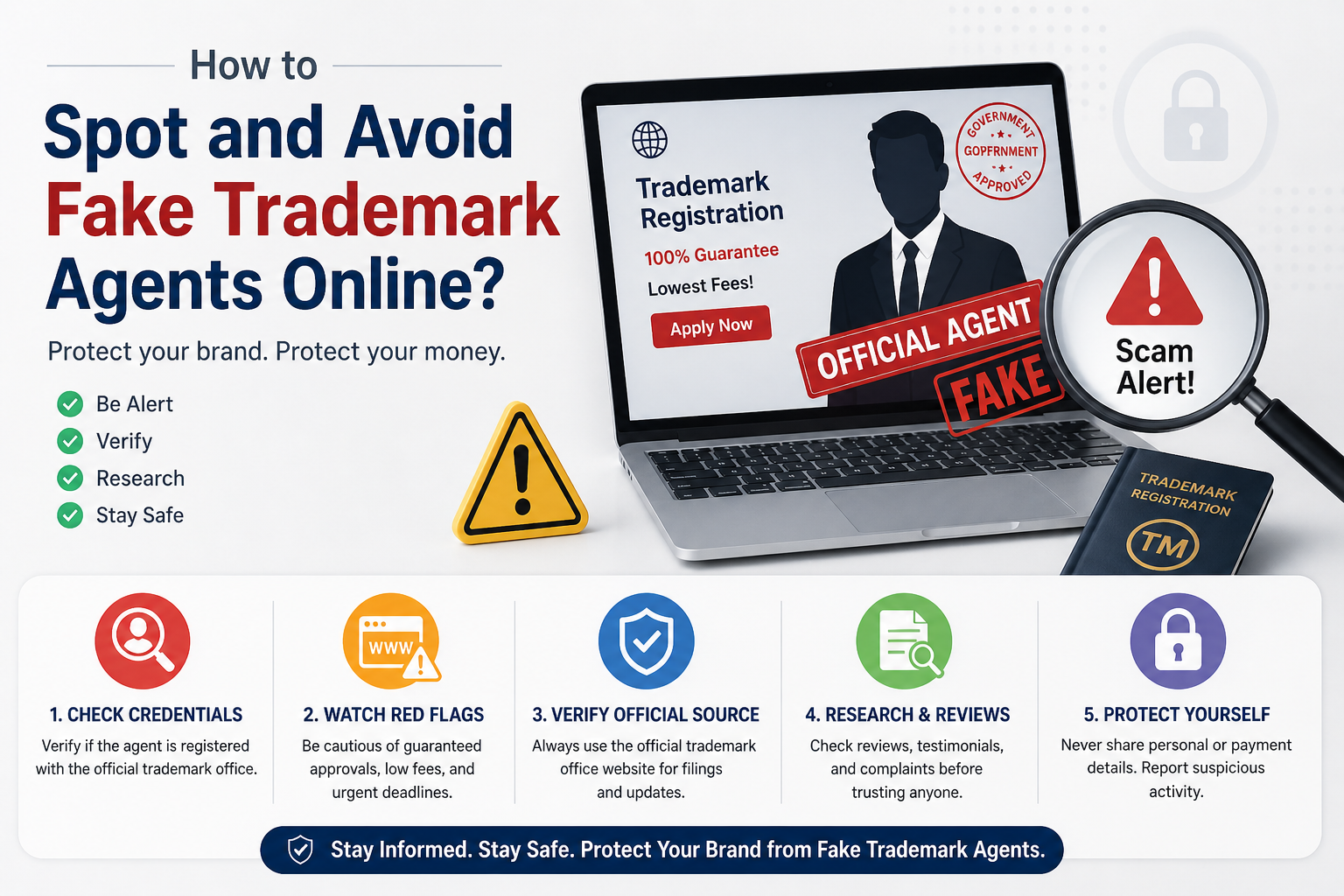
Who Are Fake Trademark Agents?
Fake trademark agents are individuals or companies that pose as legal professionals or authorized IP consultants — but have no legal qualifications, no bar registration, and no authority to represent clients before the Trademark Registry.
They typically:
- Build professional-looking websites with legal-sounding names
- Offer suspiciously low fees to attract first-time applicants
- Collect payment and personal documents — then do nothing
- File incomplete or wrong applications that get rejected
- Disappear when you ask for updates or refunds
The worst part? By the time you realize something is wrong, months have passed — and your brand is still unprotected.
10 Warning Signs of a Fake Trademark Agent
1. No Mention of a Qualified Advocate or Attorney
In India, trademark representation before the IP India Trademark Registry must be handled by a registered trademark attorney or advocate. If a website doesn’t mention any advocate’s name, bar registration number, or legal credentials — that’s a major red flag.
✅ What to do: Always ask for the name and Bar Council registration number of the attorney handling your case.
2. Prices That Seem Too Good to Be True
Trademark registration in India involves government fees (₹4,500–₹9,000 per class) plus professional fees. If someone is offering to do it all for ₹500 or ₹999 — they are either cutting dangerous corners or outright lying.
✅ What to do: Compare prices across 3–4 legitimate services. Anything significantly below market rate should raise suspicion.
3. “Guaranteed Approval” Claims
No legitimate trademark professional will ever guarantee trademark approval. The process involves examination, possible objections, and third-party oppositions — all of which are beyond anyone’s control.
If a service promises “100% approval guaranteed” or “trademark in 7 days guaranteed” — walk away immediately.
✅ What to do: Trust professionals who explain the real process honestly, including potential challenges.
4. No Physical Address or Contact Information
Legitimate firms have a verifiable office address, a working phone number, and professional email addresses (not Gmail or Yahoo). Fake agents often have only a WhatsApp number or a contact form.
✅ What to do: Google the address. Check if it’s real. Call the number and see if someone actually picks up.
5. Vague or Missing Website Details
Look carefully at the website. Does it have:
- Clear “About Us” page with real team members?
- Privacy policy and terms of service?
- Proper GST registration number?
- Client testimonials with verifiable details?
Scam websites often have stock photos, copy-pasted content, and zero transparency about who runs the company.
✅ What to do: Run a WHOIS search on the domain to check when the website was created. Many fraud sites are only weeks old.
6. No Trademark Application Number Provided
After filing your trademark application, you should receive an official application number from IP India within days. You can then track the status yourself on the IP India portal (ipindiaonline.gov.in).
If your “agent” delays sharing this number, gives you a fake one, or tells you the portal is “down” — your application may never have been filed.
✅ What to do: Always verify your application number directly on the official IP India website.
7. Pressure Tactics and Urgency Scams
“Your brand name is about to be taken by someone else — act NOW!” This is a classic scare tactic used by fraudsters to push you into making hasty decisions without doing proper research.
Legitimate agents will never pressure you. They’ll give you time to ask questions and make an informed decision.
✅ What to do: Take your time. Do your research. Urgency from a service provider is a manipulation tactic, not a legal reality.
8. Asking for Unusual Payments
Be wary if an agent:
- Asks for cash payments only
- Requests payment to a personal bank account (not a company account)
- Won’t provide a proper GST invoice
- Asks for payment in installments with no receipt
✅ What to do: Always pay via bank transfer to a registered company account. Demand a proper invoice with GST details every time.
9. No Clear Service Agreement or Receipt
A legitimate trademark service will always provide a written engagement letter or service agreement detailing what is included, the timeline, and the fees. No documentation = no accountability.
✅ What to do: Never proceed without a written agreement. Keep copies of all communications.
10. Fake “Government Portal” Websites
Some scammers create websites that look almost identical to the official IP India portal, complete with government-style logos and color schemes. They collect payment for “government fees” — and pocket it themselves.
✅ What to do: The only official trademark portal in India is ipindiaonline.gov.in. Bookmark it and always use it to verify your application status.
How to Verify a Legitimate Trademark Agent in India
Before hiring any trademark service, do these checks:
| Verification Step | How to Do It |
|---|---|
| Check advocate registration | Visit Bar Council of India website |
| Verify trademark filing | Check status on ipindiaonline.gov.in |
| Confirm GST registration | Search GSTIN on the GST portal |
| Review online reputation | Check Google reviews, Trustpilot, Justdial |
| Confirm office address | Google Maps + physical call |
What to Do If You’ve Already Been Scammed
If you suspect you’ve been defrauded by a fake trademark agent, take these steps immediately:
- Gather all evidence — emails, receipts, WhatsApp chats, documents
- Check IP India portal to see if your application was actually filed
- File a complaint with the Cyber Crime Cell at cybercrime.gov.in
- Report to the Bar Council of India if the agent falsely claimed to be an advocate
- Consult a genuine trademark attorney to assess your legal options and re-file if necessary
Final Thoughts
Your brand is one of your most valuable business assets. Protecting it with a trademark is a smart move — but only if it’s done right, by the right people.
The rise of online trademark services has made the process more accessible, but it has also opened the door to fraud. By knowing the warning signs and doing basic due diligence, you can confidently choose a legitimate service and get the protection your brand deserves.
Remember: A real trademark professional will always be transparent, honest about timelines, and happy to answer your questions. If something feels off — trust your gut and look elsewhere.
Frequently Asked Questions
Q: How can I check if my trademark was actually filed? A: Visit ipindiaonline.gov.in and search using your application number or brand name under the public search tool.
Q: Is it safe to use online trademark services? A: Yes, if they are backed by qualified trademark attorneys with verifiable credentials. Always do your due diligence before paying.
Q: What are the official trademark registration fees in India? A: ₹4,500 per class for individuals, startups, and small enterprises; ₹9,000 per class for companies — payable directly to the government.
Q: Can I file a trademark myself without an agent? A: Yes. You can file directly on the IP India portal. However, professional guidance is recommended to avoid errors that could lead to rejection.

I’m Aman Arora aka Aman G — 10+ years in SEO and Digital Marketing, and I love getting results. I don’t just do SEO & Website Design; I build strategies that work. I’m a CA drop out, but what I enjoy most is helping entrepreneurs and NGOs reach their goals. For me, happy customers are the real reward.