Views: 0
Imagine waking up one morning to find a legal notice in your inbox. A company you’ve never heard of is claiming that your software product infringes on one of their patents — and they’re demanding a hefty licensing fee or threatening to drag you into court. No product. No technology. Just a piece of paper and a lawyer.
Welcome to the world of patent trolls.
For IT companies, startups, SaaS businesses, and app developers, patent trolls are one of the most dangerous — and frustrating — threats in today’s business landscape. In this blog, we’ll break down exactly what patent trolls are, how they operate, which businesses are most vulnerable, and most importantly, how your IT company can fight back and protect itself.
Table of Contents
What Is a Patent Troll?
A patent troll — formally known as a Non-Practicing Entity (NPE) or Patent Assertion Entity (PAE) — is a company or individual that:
- Owns patents on technologies or processes
- Does NOT actually build or sell any product using those patents
- Aggressively sues or threatens to sue businesses that allegedly infringe on those patents
- Profits purely from licensing fees and legal settlements — not from innovation
Patent trolls do not create jobs, build products, or contribute to the economy. Their entire business model is litigation or the threat of it.
They typically acquire old, broad, or vaguely written patents — often from bankrupt companies or inventors who never commercialized their ideas — and then scour the market for businesses they can claim are infringing.
How Do Patent Trolls Target IT Companies?
IT companies are prime targets for patent trolls for several reasons:
1. Software patents are notoriously broad and vague. Terms like “a method for processing user data over a network” can be interpreted to cover dozens of modern apps and platforms.
2. IT companies often rely on third-party libraries, APIs, and frameworks — and any of these could potentially be covered by a troll’s patent without the company even knowing.
3. Defending a patent lawsuit is expensive. Even if you win, litigation can cost ₹50 lakhs to several crores. Many small IT companies simply settle to avoid the cost — exactly what trolls count on.
4. Startups and SMEs lack legal resources. Large companies like Google or Microsoft have in-house IP teams and war chests to fight back. Smaller IT companies don’t — making them easy targets.
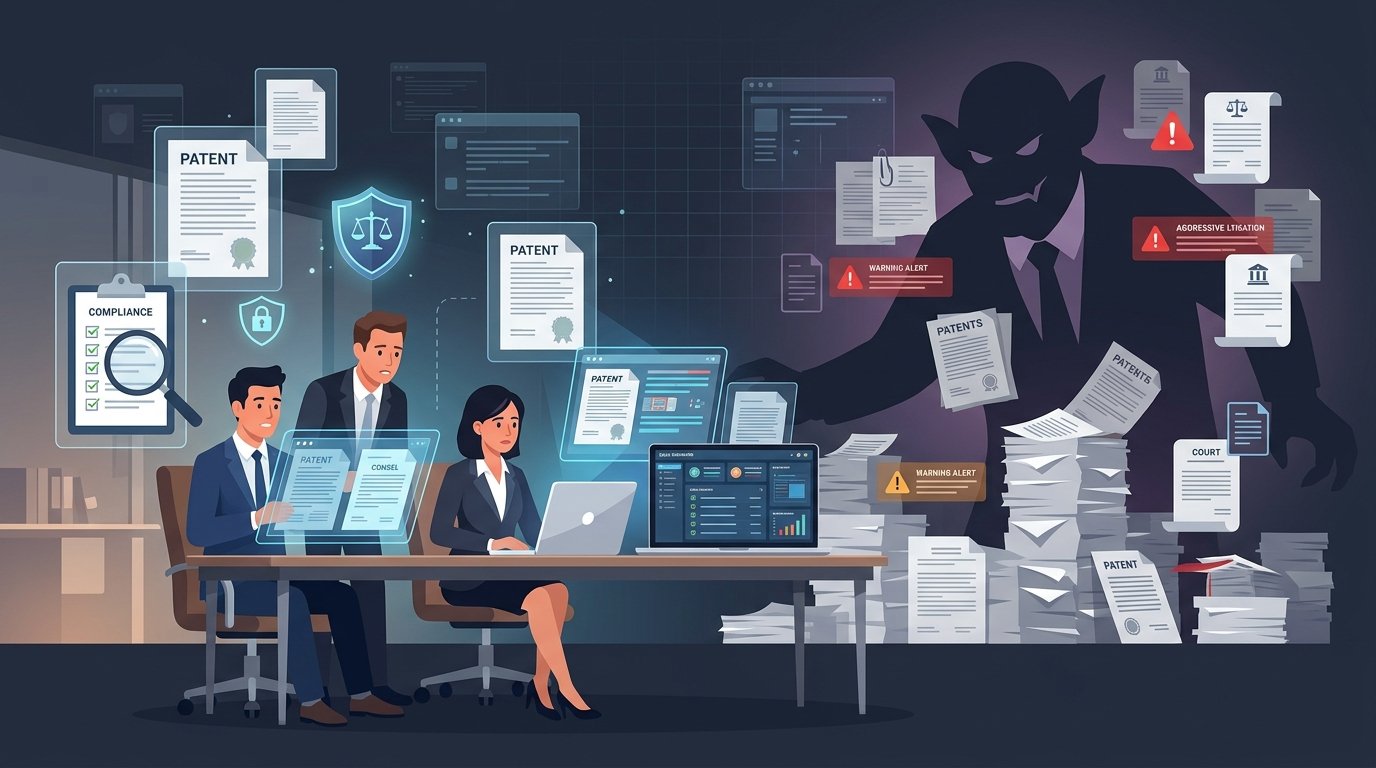
The Anatomy of a Patent Troll Attack
Understanding how trolls operate is the first step to defending yourself:
Step 1 – Acquire a Patent: The troll buys a broad, often old patent — typically one covering a general software process, networking method, or UI interaction.
Step 2 – Identify Targets: They analyze companies whose products could arguably infringe the patent. This is often done in bulk — sending hundreds of demand letters simultaneously.
Step 3 – Send a Demand Letter: You receive a letter claiming infringement and demanding a licensing fee — often ₹10 lakhs to ₹1 crore or more — framed as a “reasonable” alternative to litigation.
Step 4 – Sue or Settle: If you don’t pay, they file suit. Their goal is to force a settlement, not win in court — because winning in court costs them money too.
Step 5 – Profit: Whether you settle or fight, the troll profits. If you settle, they collect. If you fight and lose, they collect more. Even if you win, you’ve spent enormous resources defending yourself.
Real-World Examples of Patent Troll Activity in IT
While Indian courts are still evolving in this space, the global IT industry has seen massive troll attacks:
- Lodsys targeted small app developers building on Apple and Google platforms, claiming their in-app purchase mechanism infringed a patent.
- VirnetX successfully sued Apple for over $500 million related to FaceTime and VPN technology.
- Acacia Research has filed hundreds of suits against tech companies across sectors.
As India’s IT sector grows globally and Indian SaaS companies expand into US and European markets, Indian IT companies are increasingly exposed to international patent troll activity.
7 Powerful Ways IT Companies Can Defend Themselves
1. ✅ Build Your Own Patent Portfolio
The single most powerful defense against a patent troll is owning your own patents. If you have a portfolio of patents, you can counter-sue or negotiate cross-licensing agreements — making it far less attractive for trolls to target you.
If your IT company has developed any novel software process, algorithm, unique method, or technical solution, file for patent protection immediately. The Patent Registration process at Legal IP covers everything from patentability search and claims drafting to filing and examination — ensuring your innovations are legally protected before someone else claims them.
Remember: A patent is valid for 20 years from the date of filing. The sooner you file, the stronger your position.
2. ✅ Conduct Regular IP Audits
Many IT companies don’t know what IP they own — or what IP they’re potentially infringing. A comprehensive IP audit reviews:
- All software, code, tools, and processes your company has developed
- Third-party libraries, open source components, and APIs you use
- Existing patents that may cover your products or services
- Gaps in your IP protection strategy
This kind of proactive review can identify vulnerabilities before a troll exploits them. Our IP and Corporate Law team at Legal IP can guide you through a structured IP audit tailored to IT businesses.
3. ✅ Protect Your Brand and Software Identity
Patent trolls aren’t the only IP threat IT companies face. Your brand name, logo, app name, and software identity also need protection. Trademark Registration ensures that no one — troll or competitor — can legally use your brand identity to confuse customers or dilute your market position.
Similarly, the original code, UI design, and creative elements of your software should be protected through Copyright Registration. Copyright protection is automatic upon creation but registered copyright gives you much stronger legal standing in disputes.
4. ✅ Challenge the Patent’s Validity
Not all patents are valid. Many troll patents are:
- Overly broad and should never have been granted
- Prior art exists — meaning the invention was already publicly known before the patent was filed
- Obvious to a person skilled in the relevant field
In India, the Patent Office allows post-grant oppositions under the Patents Act, 1970. In the US, the USPTO’s Inter Partes Review (IPR) process allows companies to challenge the validity of a patent without going to full litigation — and it’s far cheaper than a court battle.
Working with a qualified IP attorney to challenge the troll’s patent at the patent office level can be a powerful and cost-effective strategy. Connect with the Legal IP patent team to explore this option.
5. ✅ Don’t Panic — Evaluate Before You Pay
When a demand letter arrives, the instinct is to panic and consider settling. Don’t. Many demand letters are bluffs. Before paying a single rupee:
- Have a qualified IP attorney review the patent and the infringement claim
- Assess whether your product actually infringes the patent’s claims
- Check whether the patent is valid, expired, or has existing prior art
- Determine the troll’s litigation history — have they actually sued anyone, or do they only send letters?
Knee-jerk settlements encourage more troll attacks. Fighting back — or simply demonstrating you’re prepared to fight — often causes trolls to move on to easier targets.
6. ✅ Get ISO 27001 Certified – Signal Credibility to Clients and Courts
One often-overlooked defense strategy is building organizational credibility. IT companies that are ISO 27001 certified — meaning their information security management systems are internationally accredited — are seen as more credible, more organized, and more serious by courts, clients, and regulators.
GACOICert, India’s trusted ISO certification body, helps IT companies achieve ISO 27001:2022 certification — the global gold standard for information security. An ISO-certified company demonstrates:
- Proper documentation and process controls
- Systematic management of data and intellectual assets
- A mature, compliance-first culture
This credibility matters in IP disputes — a well-organized, certified company is far better positioned legally than one that lacks documented processes. It also signals to patent trolls that you’re not an easy target.
7. ✅ Understand the Tax Implications of Patent Licensing and Settlements
If you receive a licensing demand or end up settling with a patent troll, there are important tax implications to understand:
- Licensing fee payments may attract TDS (Tax Deducted at Source) obligations, especially if the patent holder is foreign
- Royalty payments to non-residents are subject to withholding tax under the Income Tax Act
- Settlement amounts may or may not be deductible as business expenses, depending on how they’re characterized
- If you receive royalty income from your own patents, this has specific GST and income tax treatment
Getting these wrong can lead to compliance issues with the Income Tax Department. Visit LegalTax.in for expert guidance on the tax treatment of patent royalties, licensing fees, and IP-related transactions under Indian law — especially for IT companies with cross-border exposure.
What Should Indian IT Startups Do Right Now?
If you’re an Indian IT startup or SME, here’s your immediate action plan:
| Action | Why It Matters |
|---|---|
| File a Patent for your core technology | Builds your defensive IP portfolio |
| Register your Trademark | Protects your brand from misuse |
| Register your Copyright | Protects your code and creative assets |
| Conduct an IP Audit | Identifies what you own and what risks you face |
| Get ISO 27001 Certified | Adds legal credibility and client trust |
| Understand IP Tax Obligations | Avoids tax penalties on royalties and settlements |
| Engage an IP attorney | Ensures you’re never caught off guard |
The Bottom Line
Patent trolls are a real and growing threat to IT companies of all sizes. They exploit the complexity of patent law and the high cost of litigation to extract money from businesses that are actually building, innovating, and creating value.
But they are not invincible.
With a proactive IP strategy — building your patent portfolio, registering your trademarks and copyrights, conducting regular audits, and challenging weak patents — your IT company can make itself a far less attractive target.
The key is to act before you receive a demand letter, not after.
📞 Ready to build your IP defense strategy? Connect with the expert team at Legal IP today for a free consultation. Call us at +91 9555110005 or book your appointment online.
For ISO certification, visit GACOICert — India’s trusted accreditation body. For patent and IP tax queries, visit LegalTax.in.

I’m Aman Arora aka Aman G — 10+ years in SEO and Digital Marketing, and I love getting results. I don’t just do SEO & Website Design; I build strategies that work. I’m a CA drop out, but what I enjoy most is helping entrepreneurs and NGOs reach their goals. For me, happy customers are the real reward.