Views: 1
Table of Contents
Introduction
When someone starts a new business, one of the most common assumptions is:
“My company name is my brand, right? So why would I need a trademark separately?”
This is one of the most expensive misunderstandings in business — and it happens every single day.
Trademark, Brand Name, and Company Name look like they mean the same thing. They do not. Each one serves a completely different purpose — legally, practically, and commercially.
Mixing them up can cost you your business identity, your customers’ trust, and sometimes, years of legal battles.
Let’s break all three down clearly, once and for all.
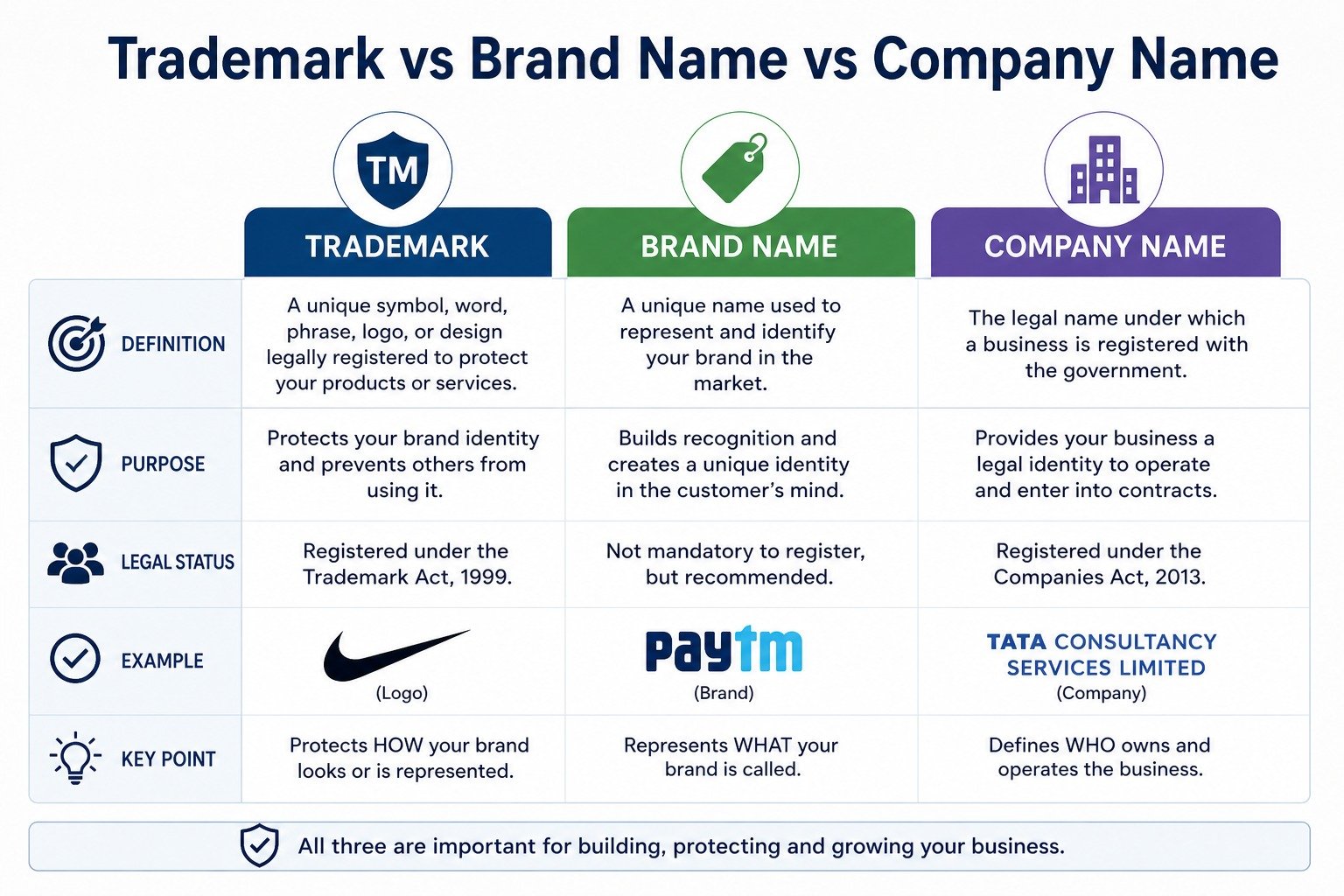
1. What Is a Company Name?
A company name is the official legal name under which your business is registered with the government.
In India, this registration happens through the Ministry of Corporate Affairs (MCA) or the Registrar of Companies (ROC) — depending on your business structure (Private Limited, LLP, OPC, etc.).
Your company name is essentially your legal identity on paper. It appears on your incorporation certificate, tax documents, bank accounts, and government filings.
Key characteristics of a Company Name:
- It is a legal requirement if you want to form a registered business entity
- It must be unique within India’s MCA database — no two registered companies can have the exact same name
- It is protected under the Companies Act, 2013
- It does not automatically protect your brand in the marketplace
Real Example:
Reliance Industries Limited is the company name. But the brands they sell under — Jio, Smart, Trends, and Ajio — are entirely separate brand names. One company, multiple brands.
Important: Just because you registered a company name does not mean no one else can use a similar name for their products or marketing. Company registration and brand protection are two different things entirely.
2. What Is a Brand Name?
A brand name is the name you give to your product or service — the face you show to the public.
It is your marketing identity. It is what customers remember, search for, talk about, and recommend. Your brand name may or may not be the same as your company name — and in many successful businesses, they are completely different.
Key characteristics of a Brand Name:
- It is what appears on your packaging, website, social media, and advertisements
- It can be registered for legal protection — but by itself, it has no automatic legal status
- A brand is more than just a name — it includes your logo, colors, tone, and customer perception
- Without a trademark, your brand name can be used or copied by anyone
Real Examples:
Hindustan Unilever Limited is the company name. Dove, Lux, Surf Excel, and Pond’s are the brand names.
Apple Inc. is the company name. iPhone, MacBook, AirPods, and Safari are the brand names.
One company. Dozens of brands. Each brand serves a different market, audience, and product category.
The hard truth: You can spend years building a brand name, growing a loyal customer base, and creating a reputation — but without a trademark, someone else can legally use the same name and there is very little you can do about it.
3. What Is a Trademark?
A trademark is a legal right that protects a specific element of your brand identity — whether that is a name, logo, slogan, color combination, or even a sound.
In India, trademarks are governed by the Trade Marks Act, 1999 and are registered through IP India (Intellectual Property India) under the Ministry of Commerce.
When you register a trademark, you receive exclusive rights to use that mark in connection with your goods or services. Anyone who copies or imitates it can be taken to court.
Key characteristics of a Trademark:
- Gives you exclusive legal ownership of your brand element
- Allows you to use the ® symbol once registration is complete
- Valid for 10 years, renewable indefinitely
- Protects against brand copying, impersonation, and infringement
- Can be licensed or sold as a business asset
The difference between ™ and ®:
- ™ (TM) — You have applied for a trademark but registration is still pending
- ® (Registered) — Your trademark has been fully approved and registered
Real Example:
The name “Zomato” and its distinctive red logo are both registered trademarks. No other company can launch a food delivery service using the same name or a confusingly similar one. If they try, Zomato has the legal right to stop them in court.
Side-by-Side Comparison
| Feature | Company Name | Brand Name | Trademark |
|---|---|---|---|
| What it is | Legal identity of your business | Public-facing identity of your product | Legal protection for your brand element |
| Where it’s registered | MCA / ROC | Not registered on its own | IP India |
| Is registration mandatory? | Yes, for a legal entity | No | No, but strongly recommended |
| Does it offer legal protection? | Only for the company name | No | Yes, full legal protection |
| Validity | As long as company is active | Indefinite | 10 years, renewable |
| Example | Tata Sons Private Limited | Tata Nexon | Tata® logo and name |
A Simple Real-Life Example
Imagine you start a skincare business.
- Company Name: Sharma Wellness Private Limited — registered on MCA. This is your legal entity.
- Brand Name: “GlowRoot” — this is the name on your products, your Instagram page, your packaging, and your website.
- Trademark: GlowRoot name + logo — registered on IP India so that nobody else can launch a skincare brand under the same name and confuse your customers.
Now here is what happens if you skip the trademark:
A competitor notices your brand growing. They register “GlowRoot” as their own trademark before you do. Overnight, they own the name legally — and you may be forced to rebrand entirely, losing all the equity you built.
This is not a hypothetical. It happens to real businesses every year.
3 Costly Mistakes Business Owners Make
Mistake 1: “I registered my company, so my brand is protected.” No. Company registration and trademark registration are completely separate processes handled by different government departments. One does not imply the other.
Mistake 2: “My brand is already famous, I don’t need a trademark now.” This is exactly backwards. The more famous your brand becomes, the more attractive it is for someone else to copy or register it. Protect it early.
Mistake 3: “Trademark registration is too expensive and complicated.” In reality, trademark filing in India starts at just ₹4,500 for individuals and startups. That is a small price compared to the cost of a rebrand or a legal dispute.
How to Register a Trademark in India
- Visit the IP India website at ipindia.gov.in
- Search for your proposed trademark to check availability
- Select the correct trademark class (there are 45 classes based on product or service type)
- File your application online or through a registered trademark attorney
- The application goes through examination and public advertisement
- If no objections are raised, you receive your Registration Certificate
Timeline: Typically 18 to 24 months for full registration. However, you can use the ™ symbol from the moment you file.
Frequently Asked Questions
Q: Can a company name and brand name be the same? Yes, they can be identical — but they do not have to be. Many large companies operate under a corporate name that is completely different from their consumer-facing brands.
Q: Is trademark registration compulsory in India? It is not legally compulsory, but it is strongly advisable. Without registration, proving ownership of a brand in court becomes significantly harder.
Q: Can one company own multiple trademarks? Absolutely. A single company can register trademarks for every product name, logo, slogan, or brand variant it operates.
Q: Does an Indian trademark protect my brand globally? No. An Indian trademark is valid only within India. For international protection, you need to file separately in each country or use the Madrid Protocol for multi-country filings.
Conclusion
Here is the simplest way to remember the difference:
- Company Name = Your legal existence
- Brand Name = Your public identity
- Trademark = Your legal armor
All three matter. But they serve very different purposes and require separate actions to establish.
If you are serious about building a business that lasts — register your company, build your brand with intention, and protect it with a trademark before someone else does.
Start by checking if your brand name is available: ipindia.gov.in

I’m Aman Arora aka Aman G — 10+ years in SEO and Digital Marketing, and I love getting results. I don’t just do SEO & Website Design; I build strategies that work. I’m a CA drop out, but what I enjoy most is helping entrepreneurs and NGOs reach their goals. For me, happy customers are the real reward.